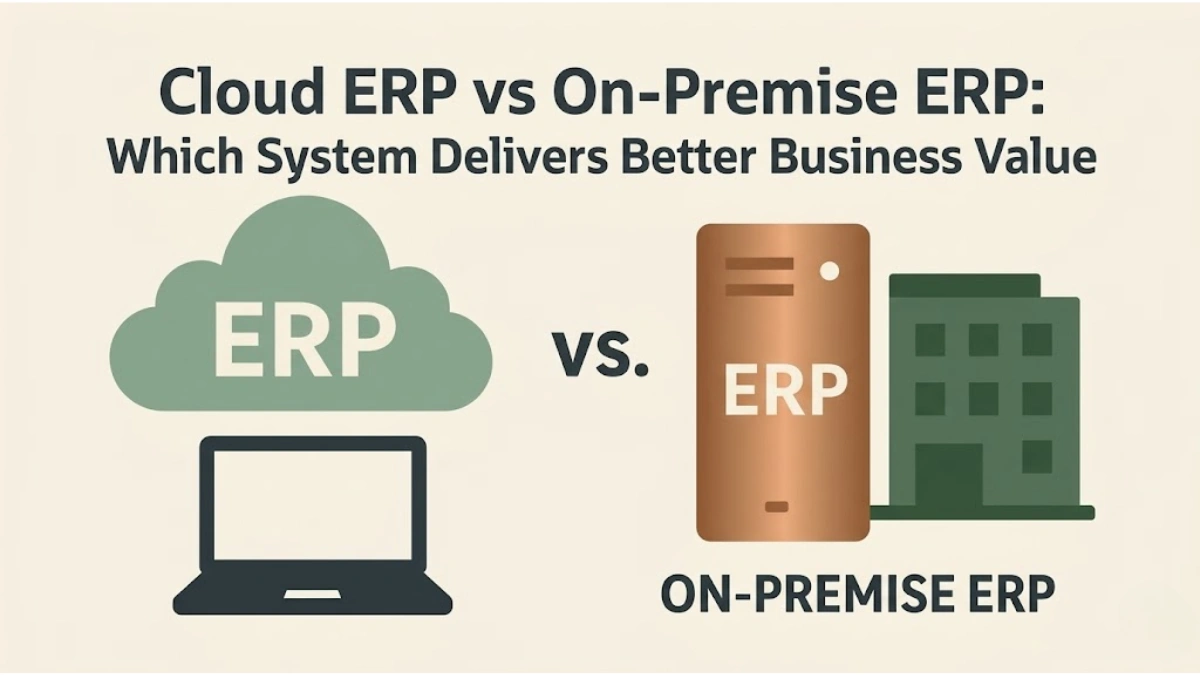
The choice between cloud ERP and on-premise ERP has emerged as a critical decision for organizations, given that ERP now oversees finance, inventory, procurement, production, reporting, and operational planning from a single unified platform. The deployment model influences not just software expenditure but also flexibility, data governance, scalability, and long-term operational effectiveness.
Companies evaluating ERP systems typically focus on how rapidly the software can be rolled out, how smoothly it can grow alongside the business, and how much in-house technical support is needed. The thorough comparison presented here makes it clear that ERP selection is no longer purely about software capabilities—it now depends significantly on organizational structure, available technical resources, and long-term digital strategy.
What Cloud ERP Means for Modern Operations
Cloud ERP operates through vendor-managed servers and is accessed via the internet.
This model has gained widespread popularity because organizations can deploy it quickly without investing in extensive internal infrastructure.
Main advantages include:
- Remote access across locations
- Automatic updates
- Lower hardware investment
- Faster implementation
- Reduced IT burden
As a result, cloud ERP is strongly favored by expanding businesses and companies operating across multiple locations.
How On-Premise ERP Works Differently
On-premise ERP is deployed directly on company-owned servers and administered in-house.
This approach gives organizations complete authority over their software environment and internal data management.
Main strengths include:
- Internal server ownership
- Full customization flexibility
- Internal security control
- Greater upgrade control
Large enterprises with well-established IT departments frequently continue to favor this approach.
Cost Structure Comparison
Cloud ERP typically operates on subscription-based pricing, distributing costs over an extended period.
This allows businesses to avoid substantial upfront capital expenditure.
Cloud ERP costs tend to be more predictable because infrastructure maintenance is handled by the vendor.
On-premise ERP generally demands significant initial spending:
- Server setup
- Licensing fees
- Technical deployment
- Internal maintenance
This results in a considerably higher early financial commitment.
Scalability for Business Growth
Cloud ERP typically scales more rapidly as business operations expand.
Organizations can add users, modules, or locations with minimal disruption.
This makes cloud-based systems particularly appealing to companies in growth phases.
On-premise ERP can also scale, but typically requires:
- Hardware expansion
- Internal technical planning
- Additional infrastructure spending
These requirements make scaling a slower process.
Security and Data Ownership
Security continues to be one of the most influential factors in the decision-making process.
Cloud ERP vendors typically offer:
- Encrypted backups
- Compliance controls
- Security monitoring
However, a portion of control still rests with the software provider.
On-premise ERP keeps all organizational data within internal systems, which is particularly appealing to heavily regulated industries.
Integration with Business Software
Cloud ERP generally integrates more seamlessly with contemporary software ecosystems.
Common integrations typically include:
- CRM platforms
- E-commerce tools
- Accounting systems
- Analytics software
This enhances overall digital workflow efficiency.
On-premise ERP frequently demands greater technical effort to achieve similar integrations.
Popular Cloud ERP Platforms Businesses Compare
| ERP Platform | Main Strength | Best For | Pricing |
|---|---|---|---|
| Microsoft Dynamics 365 Business Central | Flexible cloud deployment | Growing businesses | $70+/user |
| Oracle NetSuite | Global cloud ERP scalability | Multi-location businesses | Custom pricing |
| Odoo ERP | Affordable modular ERP | Small businesses | Free / Paid tiers |
Popular On-Premise ERP Systems
| ERP Platform | Main Strength | Best For |
|---|---|---|
| SAP Business One | Strong internal control | Medium businesses |
| Epicor ERP | Manufacturing depth | Industrial operations |
Which ERP Works Better for Small Businesses
Small businesses generally lean toward cloud ERP because:
- Lower upfront cost
- Easier deployment
- Faster learning curve
This frequently leads to improved early-stage return on investment.
Which ERP Works Better for Enterprises
Large enterprises commonly make their selection based on internal compliance demands and the depth of customization available.
Where robust IT infrastructure is already in place, on-premise ERP can still be a compelling option.
Future ERP Direction
The majority of ERP vendors are now channeling significant investment into cloud-first development strategies.
Major trends include:
- AI forecasting
- Mobile ERP dashboards
- Faster integrations
- Predictive analytics
Cloud adoption continues to expand at a rapid pace.
FAQs
1. Is cloud ERP cheaper than on-premise ERP?
Generally yes, particularly in the early stages.
2. Is on-premise ERP more secure?
It provides greater direct control over internal security.
3. Which ERP scales faster?
Cloud ERP typically scales more quickly.
4. Can manufacturers use cloud ERP?
Absolutely, a growing number of manufacturers are now embracing cloud ERP.
5. Is internet dependency a cloud ERP risk?
Yes, reliable connectivity is an important consideration.
Conclusion: Both cloud ERP and on-premise ERP deliver meaningful business value, but the right choice depends on growth objectives, technical capacity, compliance requirements, and budget structure. Organizations that align their ERP deployment model with operational realities tend to achieve stronger long-term performance outcomes.
Disclaimer: This article is intended for informational purposes only. ERP pricing, deployment options, and software capabilities are subject to change based on vendor updates and licensing terms. Organizations should confirm official product details with vendors before making an ERP selection.