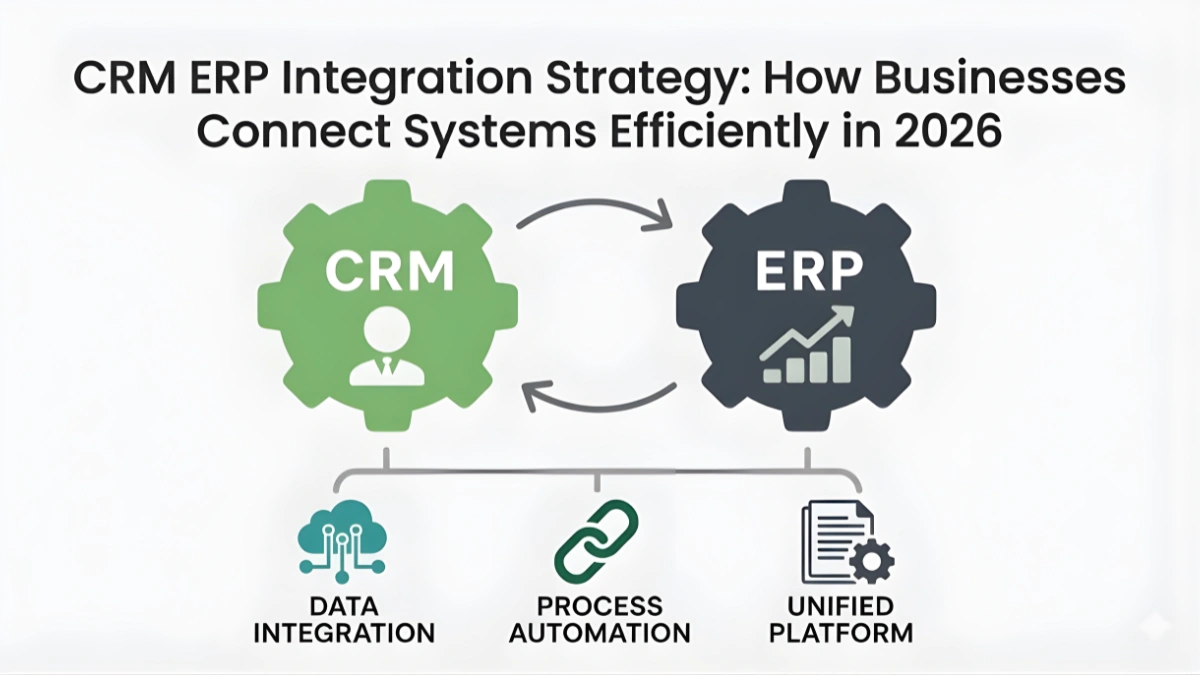
Connecting CRM and ERP systems has emerged as one of the most critical digital initiatives for organizations, since customer data, financial records, inventory, operations, and sales decisions must now flow through a single unified ecosystem. When CRM and ERP operate in silos, organizations frequently encounter duplicate records, delayed decisions, inconsistent reporting, and slower response times for customers.
A well-designed integration strategy enables customer-facing teams and back-office teams to operate from the same real-time data. The framework presented here clearly demonstrates that CRM and ERP integration is now regarded as a fundamental business efficiency initiative, as it enhances cross-departmental visibility and reduces reliance on manual processes.
Why CRM and ERP Integration Matters
CRM manages customer relationships while ERP oversees internal business operations.
When both platforms work in tandem, organizations benefit from:
- Unified customer records
- Faster order visibility
- Better financial accuracy
- Improved service coordination
This fosters more informed decision-making across all departments.
How Integrated Systems Improve Daily Operations
Without integration, sales teams frequently operate independently from finance and inventory teams.
This leads to delays because customer information must be verified through manual processes.
Connected systems address this by enabling:
- Real-time order visibility
- Inventory access during sales conversations
- Invoice visibility across departments
This accelerates overall business operations.
Main Business Benefits of CRM + ERP Integration
Organizations that link both systems typically see improvements in:
- Forecasting accuracy
- Order processing speed
- Internal reporting quality
- Customer service consistency
This generates tangible operational value for the business.
Top Integration Tools Businesses Commonly Use
| Integration Tool | Main Strength | Pricing | Best For |
|---|---|---|---|
| MuleSoft Anypoint | API integration and data mapping | Custom pricing | Large enterprises |
| Zapier | Fast workflow automation | Free / Paid tiers | Small and medium businesses |
| Microsoft Power Automate | Enterprise automation | $15+/user | Microsoft ecosystem users |
| Make | Flexible visual automation | Free / Paid tiers | SMB automation projects |
How API Integration Helps
API integration continues to be one of the most effective approaches because it enables systems to exchange data directly with one another.
This method typically supports:
- Customer updates
- Order sync
- Invoice movement
- Inventory visibility
This enhances real-time system performance.
Why Middleware Is Popular
Middleware solutions allow businesses to sidestep the complexity of custom development work.
They streamline integration by building workflow bridges that connect disparate systems.
This approach is particularly effective when organizations require rapid deployment.
Common Integration Challenges
A number of obstacles tend to surface when planning a CRM and ERP integration project.
The most frequently encountered include:
- Data inconsistency
- Duplicate records
- Weak field mapping
- Process confusion
These problems typically arise when the initial planning phase is inadequate.
Why Data Quality Matters First
Prior to beginning integration, businesses should thoroughly clean and verify their existing records.
Poor data quality frequently leads to:
- Wrong reporting
- Duplicate customer profiles
- Invoice mismatches
This undermines the overall value that integration is meant to deliver.
Why Employee Adoption Is Important
Even a well-built integration will fall short if teams fail to embrace the updated workflow.
Organizations typically boost adoption rates by investing in:
- Process training
- Clear usage guidelines
- Department coordination
This enables integrated systems to deliver their full potential value.
Long-Term Value of CRM + ERP Integration
When integration functions as intended, businesses gain enhanced visibility across:
- Sales
- Finance
- Inventory
- Customer service
This strengthens long-term operational control throughout the organization.
FAQs
1. Can all CRM systems connect with ERP software?
Most contemporary platforms are built to support integration.
2. Is custom integration always necessary?
No, middleware solutions frequently prove sufficient.
3. Which tool is best for small businesses?
Zapier continues to be a widely used option.
4. Does integration improve customer service?
Yes, quicker access to data leads to better response quality.
5. Is ERP + CRM integration expensive?
The cost varies based on the complexity of the systems involved.
Conclusion: CRM and ERP integration has become indispensable because modern businesses rely on connected data spanning both customer management and internal operations. Organizations that successfully integrate both systems tend to see meaningful gains in efficiency, reporting quality, and long-term strategic decision-making.
Disclaimer: This article is intended for informational purposes only. Integration tools, software capabilities, and pricing are subject to change based on vendor updates and individual business needs. Organizations should confirm official product details with vendors before proceeding with implementation.